From the Warring States to the runway—how a 3,000-year-old silk tradition survived empires, decline, and is now finding new life in the 21st century.
Where It All Began: Legends, Kings, and Silkworms
The story of Shu brocade does not begin with a loom. It begins with a legend.
More than 3,000 years ago, according to ancient accounts, the first king of the Shu kingdom—a figure named Can Cong—taught his people to raise silkworms in the Chengdu Plain. His name literally means “silkworm gatherer,” and he is remembered as the founder of sericulture in what is now Sichuan Province.
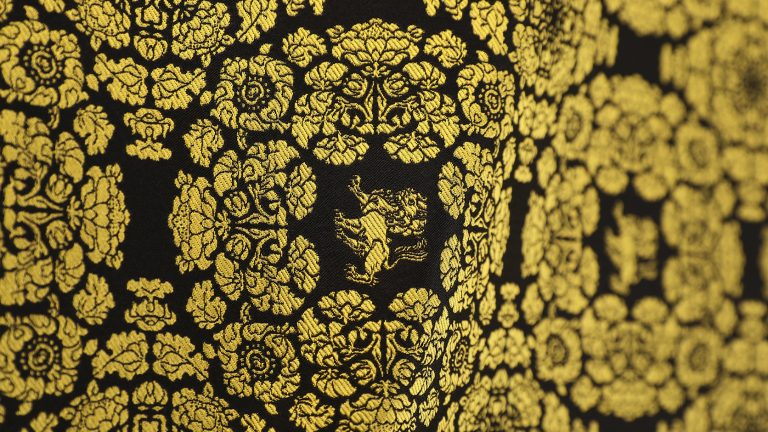
Sichuan’s history of silk production can be traced back over 4,000 years, when the region was known simply as Shu. By the Spring and Autumn period (770–476 BC), the fabric produced in Chengdu had become distinctive enough to earn its own name: Shu brocade. The earliest records describe it as “vivid in pattern, refined in weave, and brilliant in color”—a reputation that would follow it for the next two millennia.
The Southern Silk Road: Older Than the Silk Road You Know
Most Western readers know the Silk Road as the ancient trade route connecting China to Europe. What they usually don’t know is that a southern route started earlier—and Shu brocade was its first major export.
During the Warring States period (403–221 BC), Shu brocade was already being exported throughout Asia via what historians call the Southern Silk Road. This route began in Chengdu, passed through Yunnan Province into Myanmar and India, and eventually reached Central Asia and Europe. It was active approximately 200 years before the northern Silk Road.
The trade was not merely commercial. Shu brocade became a strategic resource. By the time of the Western Han Dynasty (206 BC–AD 24), the imperial court appointed a dedicated official—the Brocade Officer—to oversee its production and quality. The Brocade Officer functioned like a Minister of Textiles. Crucially, he was stationed not in the imperial capital of Chang’an (modern Xi’an), but in Chengdu—a clear signal of how vital Sichuan’s brocade industry was to the empire.
That decision left a permanent mark on the city. Chengdu became known as Jinguan Cheng—the City of the Brocade Officer. The river that runs through the city was renamed the Jin Jiang—the Brocade River—because weavers washed finished brocade in its waters to enhance the colors. Even today, Chengdu’s streets and landmarks carry the character jin: Jinli, Jinjiang, Jinguan Yi.
The Han Dynasty: Weaving Technology That Rewrote History
The Han Dynasty was the period when Shu brocade evolved from a regional specialty into a technological marvel.
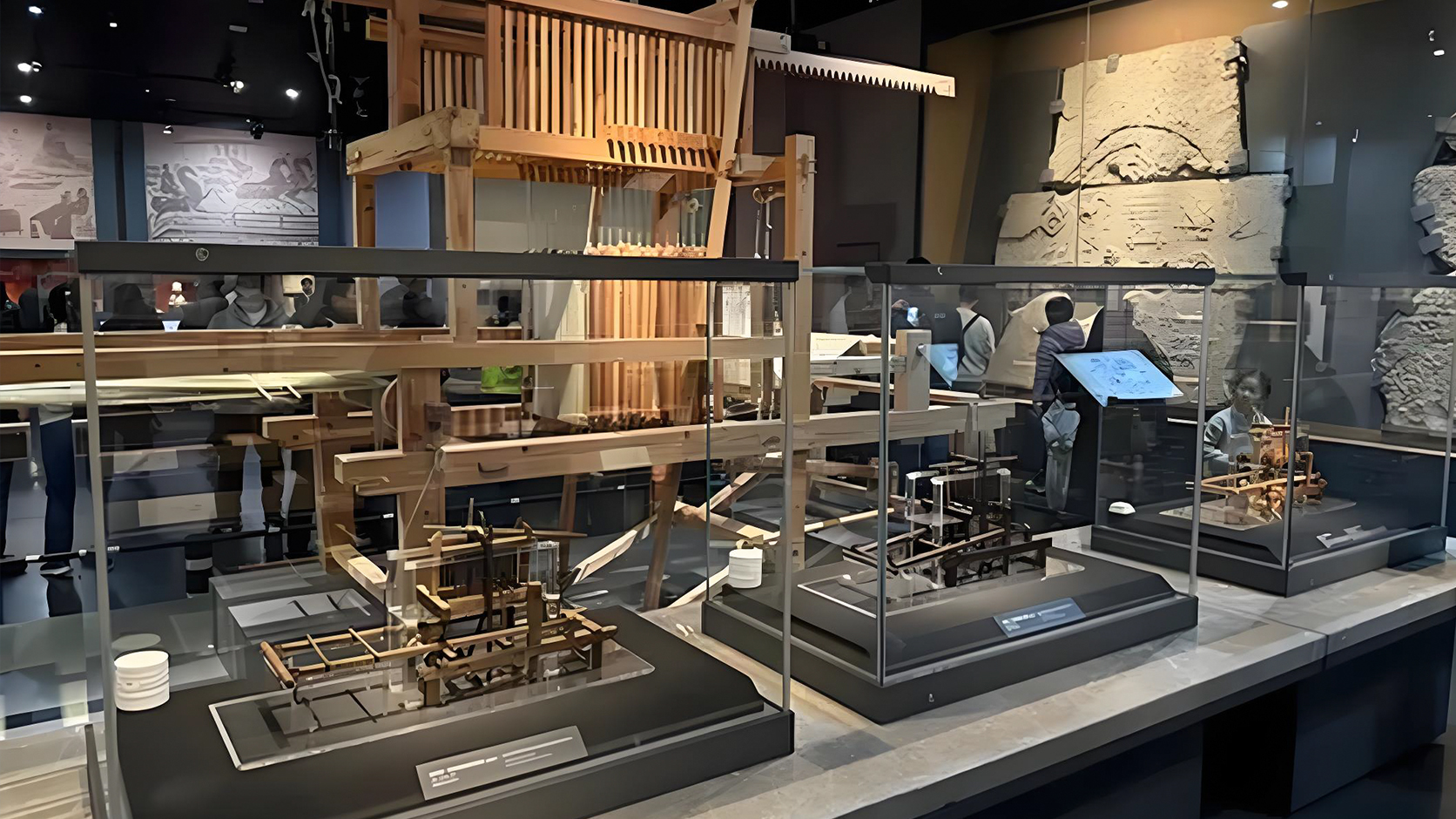
In 2012, archaeologists excavating the Laoguanshan Han Tomb in Chengdu unearthed four wooden jacquard loom models dating to the Western Han period—the first such discovery in Chinese archaeological history. These models, preserved in water for over 2,000 years, revealed that Han Dynasty weavers had already developed link-rod type multi-heddle jacquard looms capable of producing complex figured patterns.
The significance of this discovery cannot be overstated. It filled a major gap in the world history of textile technology. Before Laoguanshan, the sophistication of Han Dynasty silk weaving was known only from written records and surviving fragments of fabric. The loom models proved that Chengdu was not just a center of production—it was a center of innovation. The city’s claim to the name “Jin Cheng” (Brocade City) was now backed by physical evidence.
A reconstructed version of one of these looms—the “link-rod type single-hook multi-heddle jacquard wooden loom” —was displayed at the Chengdu Museum in 2016. A skilled weaver using the reconstructed loom produced only about 10 centimeters (4 inches) of brocade in four days. This production rate is a reminder that the phrase “an inch of brocade, an inch of gold” was not poetic exaggeration. It was an economic reality.
The Tang Dynasty: The Golden Age
If the Han Dynasty built the foundation, the Tang Dynasty (618–907 AD) built the summit.
During the Tang, Shu brocade entered what historians unanimously call its golden age. The Zhenguan and Kaiyuan eras of stable governance created unprecedented demand for luxury goods, and Shu brocade was the luxury good of choice. Production scale and technical skill both reached their peak. Shu brocade came to represent the highest level of ancient Chinese silk weaving.
The numbers are staggering. In the late Tang period, Chengdu’s silk workshops—government-run and private combined—employed approximately 120,000 artisans, about 3.5% of the local population. Annual output of high-grade silk fabrics including brocade, damask, and gauze reached over 110,000 bolts, with total silk production across all grades estimated at around 2 million bolts per year.
Shu brocade was not just a commercial product. It was political currency. When Emperor Xuanzong fled to Sichuan during the An Lushan Rebellion, he used 100,000 bolts of Shu brocade to restore morale among his mutinous troops. Historical records note that the emperor himself wore five-colored Shu brocade described as a “rare object,” and Princess Anle’s dragon skirt of single-thread gauze was said to “float like cloud and smoke.”
From the Tang onward, Shu brocade traveled in every direction: north to Chang’an and onward to the Western Regions, south through Yunnan into Southeast Asia, and east to Japan. Tang poets praised its magnificence. Japanese envoys carried it home. The famous Nishijin brocade of Kyoto—still one of Japan’s national treasures—traces its lineage directly to Tang Dynasty Shu brocade.
Song and Yuan: Institutionalization and Adaptation
The Song Dynasty (960–1279 AD) brought a different kind of development. The state took a more direct role in managing production. In Chengdu, the Song governor Lü Dafang established the Chengdu Brocade Institute, known as the “Brocade Official Tower,” maintaining a large-scale production apparatus.
More significantly, the Song court expanded three Tea-Horse Bureau Brocade Institutes in Chengdu specifically to produce brocade for trading with frontier peoples for warhorses. Shu brocade became a tool of statecraft—a luxury good exchanged for military necessity. This practice not only stimulated production but also embedded Shu brocade in a cross-regional political economy that linked the Central Plains, the Tibetan Plateau, and the southwestern frontiers.
The Yuan Dynasty continued this institutional approach, establishing a Weaving and Dyeing Bureau to manage Shu brocade production. Throughout this period, Shu brocade techniques continued to evolve, absorbing influences from Central Asian and Tibetan aesthetics while maintaining its distinctive warp-faced structure.
Ming and Qing: Decline and Fragile Recovery
The Ming Dynasty (1368–1644) brought catastrophe. In the chaos of the dynasty’s final years, Chengdu’s brocade workshops were “completely destroyed, with no patterns remaining.” The industry that had survived two thousand years of dynastic change nearly vanished.
Recovery was slow. When the Qing Dynasty restored order, Shu brocade production gradually resumed—but the world had changed. The Jiangnan region (modern Jiangsu and Zhejiang provinces) had emerged as China’s new silk center. Shu brocade, once the undisputed leader, found itself competing with newer traditions like Song brocade and Yun brocade that had risen in its shadow.
By the late Qing and Republican periods, the situation worsened. The Opium Wars opened China’s markets to foreign goods. Machine-made textiles from Europe and Japan flooded the country. Shu brocade, with its slow handwoven production and high cost, could not compete on price. The industry entered a period of deep decline.
The 20th Century: Collapse, Revival, and Collapse Again
The story of Shu brocade in the 20th century is a story of dramatic swings.
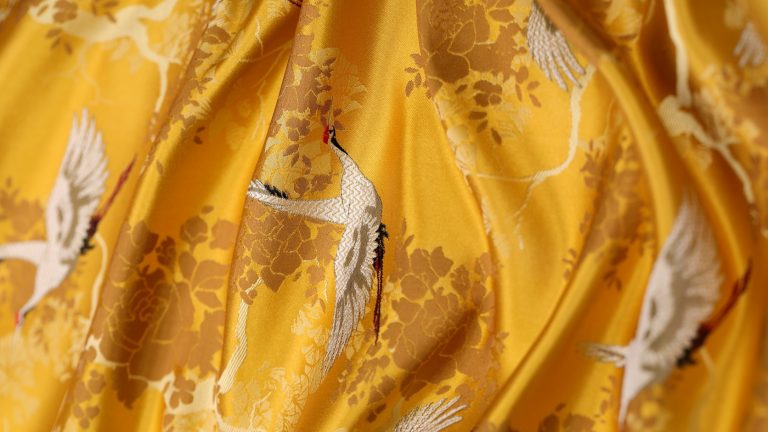
After 1949, the new government supported the revival of traditional crafts. Unemployed brocade workers were organized to restart production. In the 1950s and 1960s, designers created new patterns—phoenixes among peonies, cranes in pines, dragons and phoenixes bringing auspiciousness—and revived 84 lost pattern designs and traditional weaving structures that had been forgotten for forty years. New designs inspired by Chengdu’s cultural landmarks—Du Fu’s Thatched Cottage, the Wuhou Shrine, the Wangjiang Tower—were also introduced.
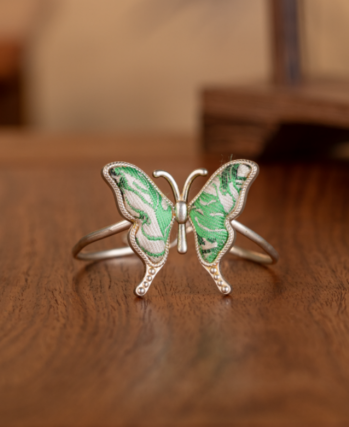
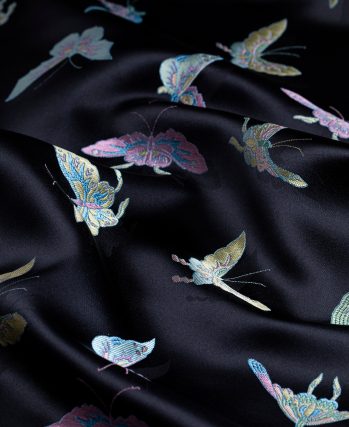
The 1980s brought another wave of revival. A new generation of designers worked alongside veteran artisans to systematically excavate and reorganize Shu brocade traditions, producing new versions of Ming Dynasty classics like the Badayun (Eight Great Clouds) brocade, butterfly-pattern brocade, and the Fortune-Prosperity-Longevity-Joy pattern.
But the revival was not sustainable. In 2003, the Chengdu Shu Brocade Factory—the flagship of the industry—formally closed. The industry entered another period of crisis. A new generation of all-iron looms appeared around 2007, but they failed to achieve meaningful breakthroughs in efficiency or quality. Research and development on next-generation looms stalled. The industry that had once employed 120,000 people in a single city now struggled to survive.
The 21st Century Turnaround: Technology, Heritage, and New Markets
The turning point came from an unexpected direction: technology.
In 2006, Shu brocade weaving techniques were among the first crafts designated as National Intangible Cultural Heritage by China’s State Council. In 2009, they were included in UNESCO’s Representative List of the Intangible Cultural Heritage of Humanity as part of China’s traditional sericulture and silk craftsmanship.
But recognition alone does not pay weavers. The real change came from production tool innovation.
The Chengdu Ancient Shu Brocade Research Institute began systematically replacing old looms. In 2025, after relocating to the Shuangliu Shu Brocade Cultural and Creative Park, the institute completed technical upgrades on more than 10 imported looms, achieving monthly output eight times that of the old equipment. Where a wooden loom once produced 30 centimeters per day, and a semi-wooden loom managed just over a meter, modern rapier looms now produce 10 times what a semi-wooden loom could achieve. The result: the price of one meter of Shu brocade dropped from over 10,000 RMB to around 1,000 RMB—a tenfold reduction that made it accessible to ordinary consumers.
A new generation of looms developed by companies like Jinyi Tiancheng pushed efficiency even further. These looms—over 7 meters tall and weighing 8 tons—can produce approximately 40 meters of Shu brocade per day, a 20-fold increase over previous models. A single worker can now operate eight looms simultaneously, compared to one loom per worker in the past. The new looms also improved quality: a single width of 1.4-meter brocade is composed of 40,000 silk threads, each averaging half the thickness of a human hair. The result is finer patterns, smoother color gradients, and dramatically reduced defects.
Alongside hardware innovation came software innovation. AI-powered design tools have broken through the traditional bottleneck of pattern creation. The Shu Brocade and Embroidery Institute in Chengdu’s High-tech Zone developed a “image-to-image” custom design workflow that uses AI image processing to transform customer photographs into bespoke brocade patterns. A design that once took two years and five revisions—such as the Jiaozi Market Scene with over 500 figures—can now be finalized in one to two months. The institute holds two national patents and over 700 copyrights, and its AI-assisted works have been exhibited in Italy, South Korea, and Uzbekistan.
The Industry Today: From 9 Million to 50 Million—and Beyond
The impact of these changes is measurable.
Between 2023 and 2025, Chengdu’s Shu brocade industry experienced rapid growth. The number of Shu brocade enterprises increased from 8 to 10. The number of provincial-level or higher intangible cultural heritage inheritors grew from 4 to 6. Annual output value jumped from 9 million RMB to approximately 50 million RMB. A total of over 20 brocade enterprises and workshops are now clustered in the Chengdu area, and the industrial agglomeration effect is beginning to take shape.
To put this in perspective: Yun brocade currently generates 140 million RMB in annual output, and Song brocade generates 300 million RMB. Shu brocade, at 50 million RMB, is the smallest of the three—but also the one with the largest room for growth.
Breaking Out: Fashion Weeks, Cross-Industry Collaborations, and International Stages
The most visible sign of Shu brocade’s revival is its presence on international fashion stages.
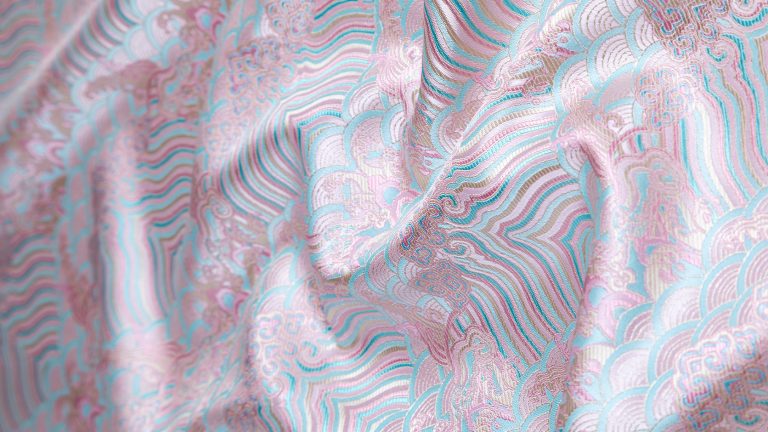
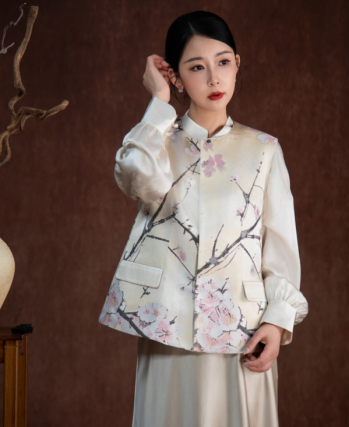
In March 2026, a dedicated Shu brocade ready-to-wear showcase was held at China Fashion Week in Beijing. Sixty garments walked the runway, translating Shu cultural symbols—the sun-and-bird gold ornament, hibiscus flowers, Dujiangyan water patterns—into wearable fashion. The collection was a collaboration between Fuzhen FUGENT, a company based in the Shuangliu “Jin SHOW” cultural park, and renowned designer Zeng Fengfei. The park is now home to multiple Shu brocade brands, including the workshop of Hu Guangjun, a national-level intangible cultural heritage inheritor.
The international reach extends beyond China. In November 2025, Chengdu designers Wang Xiaoran and Bi Jinpei presented a collection integrating Shu brocade and Shu embroidery at the 8th Seychelles Fashion Week, competing alongside designers from Russia, South Africa, and Uganda. The collection showcased “the unique charm of Chinese intangible cultural heritage that transcends national borders.”
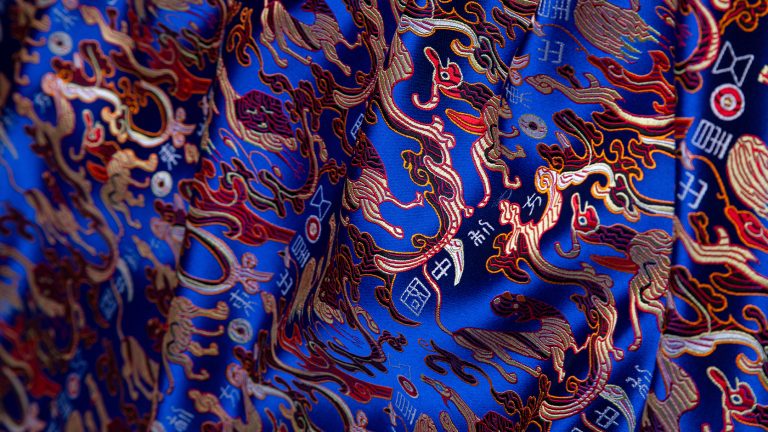
Cross-industry collaborations have brought Shu brocade into everyday consumer life. A partnership with Luckin Coffee—China’s largest coffee chain—produced a “Shu Brocade Intangible Heritage Cup” featuring classic Kuailong (Kui Dragon) and Yunqi (Cloud and Qi) patterns. It sold 1.85 million cups on its first day. The medal ribbons for the Chengdu Universiade incorporated Shu brocade craftsmanship, compressing elements like hibiscus flowers, the sun-and-bird symbol, and the chessboard pattern into the ribbon design.
In December 2025, Jinyi Tiancheng signed a strategic partnership with China Post to launch the “Jinshu Chuanyi” dual-IP cultural and creative series, using the national postal network to distribute Shu brocade products across China and internationally. A parallel collaboration with artist Xu Liaoyuan and his design museum launched the “Splendid Rainbow Plan,” positioning Shu brocade as a core cultural IP across multiple sectors: cultural products, art creation, fashion design, cultural tourism, and digital collectibles.
What This Means for the Future
Shu brocade’s modern trajectory offers a case study in how a traditional craft can survive—and thrive—in a globalized economy.
The pattern is consistent across the successful examples: technology reduces cost, design maintains relevance, and storytelling creates value. The new looms did not replace the handwoven tradition; they created a parallel production tier that serves a broader market. AI design tools did not eliminate human creativity; they accelerated it. International collaborations did not dilute Shu brocade’s identity; they amplified it.
For an American audience encountering Shu brocade for the first time, the story is compelling on multiple levels. It is a story of technological innovation that predates the Industrial Revolution. It is a story of cultural survival against enormous odds. And it is a story of a 3,000-year-old craft finding its place in the modern world—not as a museum piece, but as a living, evolving textile with a future as rich as its past.
Shu brocade weaving techniques were designated National Intangible Cultural Heritage in 2006 and inscribed on UNESCO’s Representative List of the Intangible Cultural Heritage of Humanity in 2009.