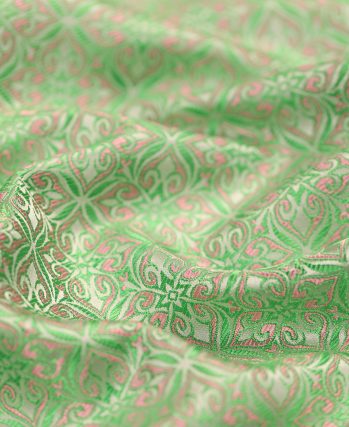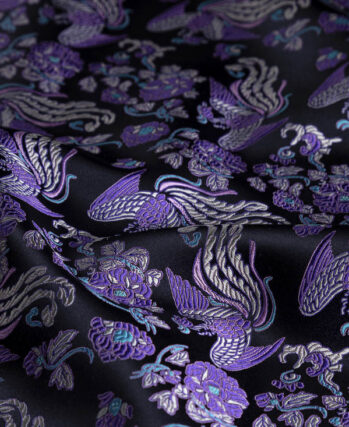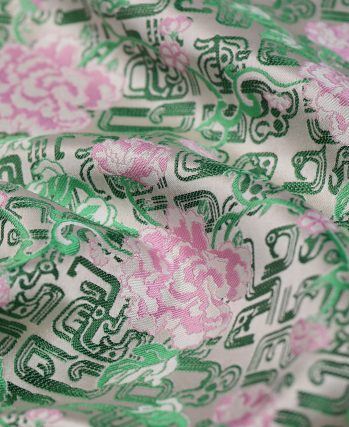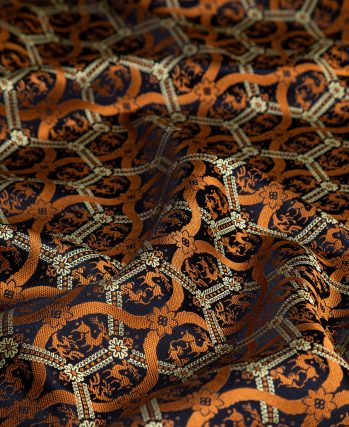
Both are made from silkworms. But one is a flat sheet of cloth—and the other is a three-dimensional work of art.
The Short Answer
When most people in the West hear the word “silk,” they picture a smooth, lustrous fabric—something like a silk scarf, a slip dress, or a pillowcase. That image is accurate, but it describes only one category of silk: plain-weave silk.
Shu brocade (蜀锦, Shǔjǐn) is silk—but it is a fundamentally different kind of silk fabric. It belongs to a category called figured silk (提花锦缎), and its construction, production method, visual complexity, and cultural significance set it apart from ordinary silk in ways you can see and feel.
Here’s the simplest way to think about it:
Ordinary silk is a fabric. Shu brocade is a woven structure.
The Core Difference: Plain Weave vs. Figured Weave
Ordinary Silk: The Simple Cross
Most silk fabric you encounter in the West—charmeuse, habotai, crepe de chine, taffeta—is built on what textile specialists call plain weave (平纹组织). The principle is almost childishly simple: one warp thread goes over one weft thread, under the next, over the next, and so on. The pattern repeats in a simple grid.
Plain-weave silk is beautiful because of what it is: smooth, reflective, fluid. Its beauty comes from the fiber itself—the natural protein structure of the silkworm’s cocoon—not from the way it is woven.
This is why plain silk can be produced relatively quickly and affordably. There is no complex pattern to program. No color coordination across dozens of thread types. The loom does one thing, and it does it consistently.
Shu Brocade: The Woven Picture
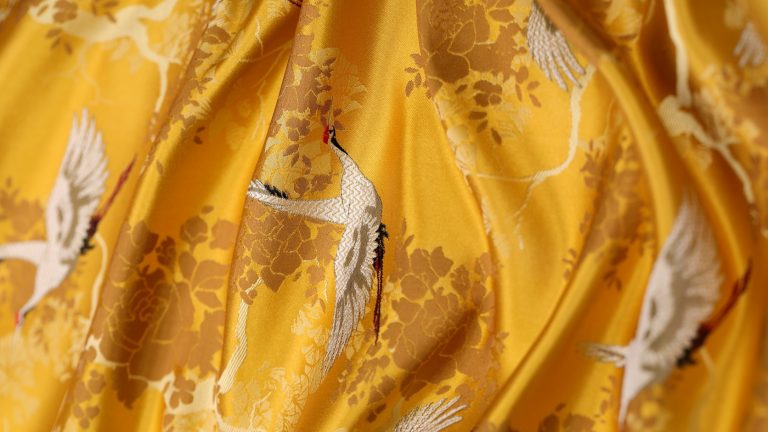
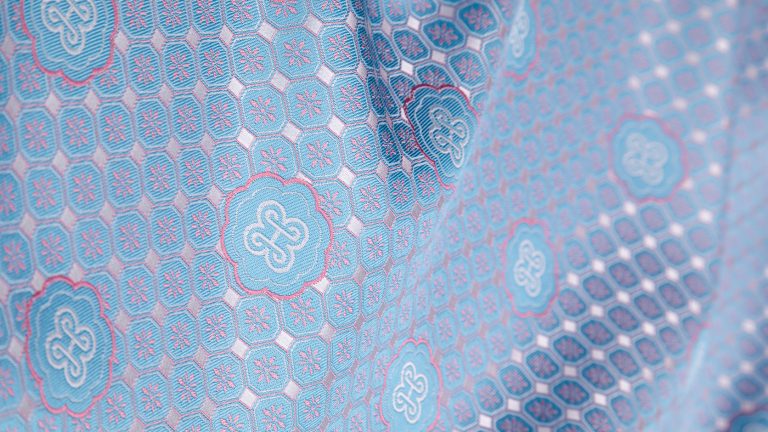
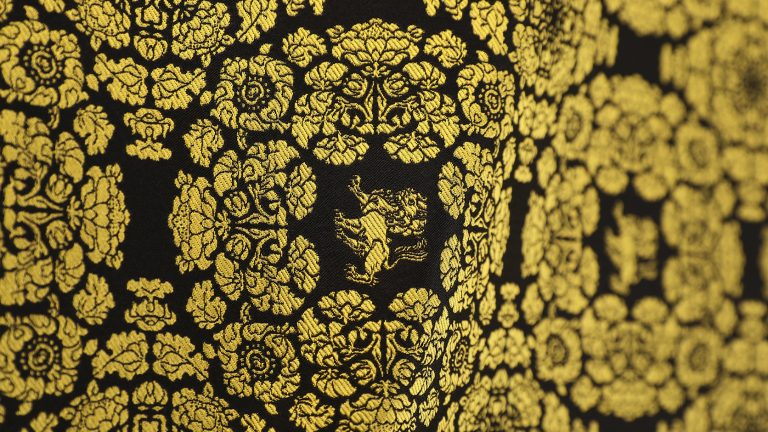
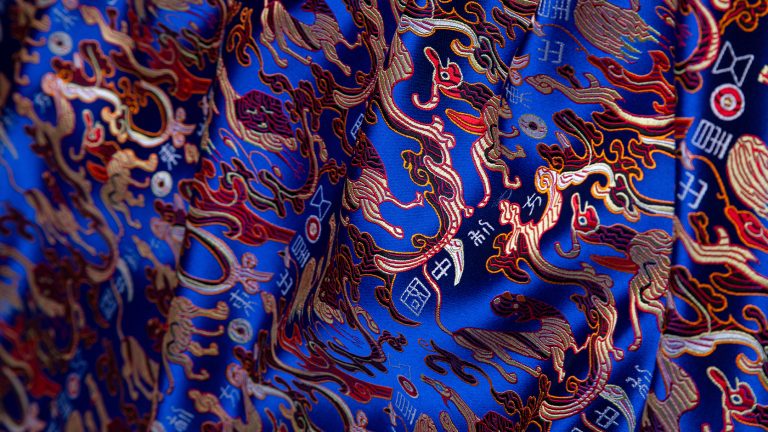
Shu brocade operates on an entirely different level of complexity. It is defined as a “figured brocade silk fabric” (提花锦缎类织物)—meaning the patterns are not printed, embroidered, or applied to the surface. They are woven into the structural core of the cloth itself using a jacquard mechanism.
In plain weave, one warp meets one weft in a simple binary pattern. In Shu brocade, multiple layers of colored warp and weft threads interact simultaneously. A single point in the fabric may involve a decision among dozens of possible thread combinations.
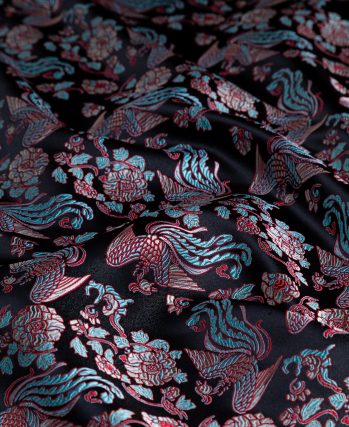
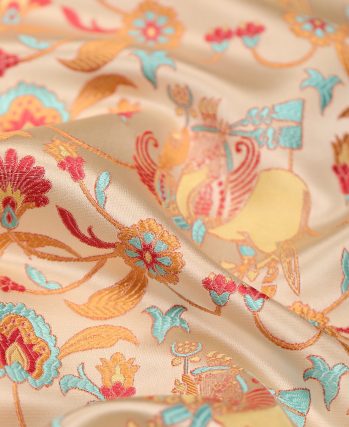
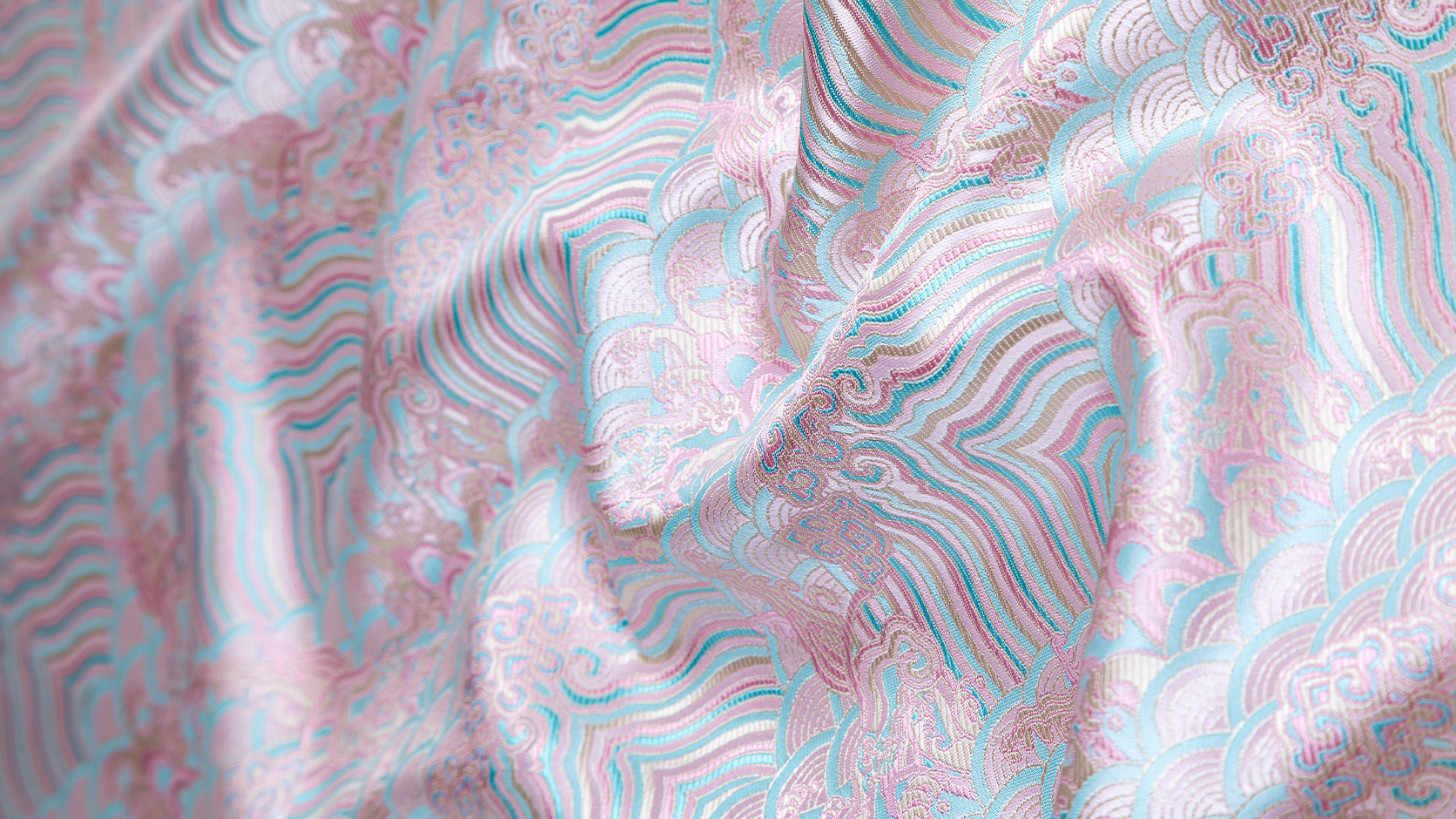
The result is fabric with dimensional depth. Run your fingers across a piece of Shu brocade and you can feel the pattern. Tilt it in light and the colors shift because different thread groups catch illumination at different angles. The pattern is not on the cloth. It is the cloth.
Structural Differences: What Makes Shu Brocade Unique
1. Warp-Faced vs. Weft-Faced Construction
Most brocades produced around the world—including later Chinese traditions like Song brocade (苏州宋锦) and Yun brocade (南京云锦)—are weft-faced. The pattern is created primarily by the horizontal threads (the weft), which are inserted over a simpler warp structure.
Shu brocade is different. Its defining technique is multi-warp figuring (多重经起花). The pattern is built primarily from the vertical threads (the warp), using a method called warp-faced weaving. This is not a minor technical footnote. It is the reason Shu brocade has a uniquely dense, tight, almost carved appearance. The vertical threads are pulled so tightly that the surface has a subtle relief texture that plain silk completely lacks.
Later, Shu brocade weavers developed an even more sophisticated approach: combining both warp and weft figuring in a single fabric. A famous example is the Shu brocade reproduction of the Qing Dynasty painting Along the River During the Qingming Festival, which employed seven shuttles, thirty-six colors, and simultaneous warp-and-weft patterning to achieve its extraordinary visual depth.
2. The “Color Organizing” Problem
Here is something that plain silk never has to solve: how to arrange colors before weaving begins.
In plain silk production, you can weave first and dye later. The fabric is uniform, so the dye absorbs evenly. Easy.
In Shu brocade, this approach is impossible. The colors must be in the threads before a single pick of the shuttle is thrown. This means the production process begins not at the loom but at the dye vat and the warping frame.
Traditional Shu brocade used natural plant and mineral dyes—indigo, safflower, gardenia, and others—applied to raw silk filaments before weaving. The lian ran (炼染) process—refining and dyeing the silk—was a specialized craft in its own right, requiring years of training to master. Dye formulas had to be adjusted based on temperature, humidity, and the specific batch of silk. This kind of knowledge existed only in the hands and eyes of experienced practitioners.
A particularly distinctive Shu brocade technique is the “hand-change-hand” (手换手) warping method used for Yuehua (Moonlight) brocade. When arranging the colored warp threads, the weaver must periodically swap out groups of thread spools to create a gradual, cloud-like color transition across the fabric’s width. No other Chinese brocade tradition uses this technique. It is exclusive to Shu brocade.
3. Time Cost: 120 Picks Per Centimeter
Perhaps the most visceral difference between Shu brocade and ordinary silk is time.
Plain silk can be woven on modern power looms at speeds measured in meters per minute. Even handwoven plain silk is relatively efficient by textile standards.
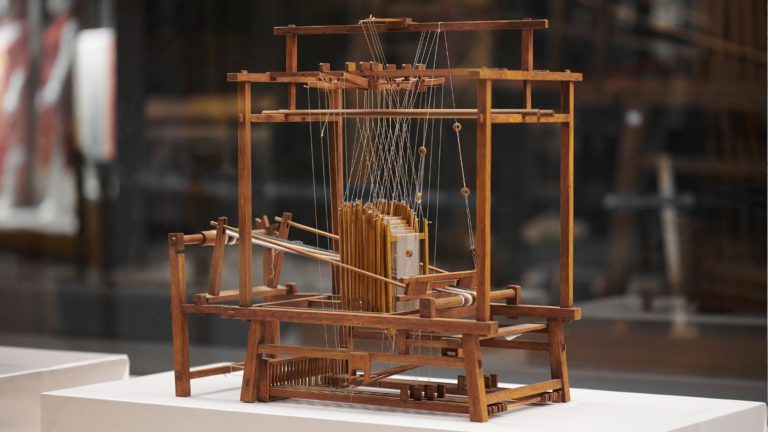
Shu brocade is measured in a different unit entirely. According to master weavers, one centimeter of handwoven Shu brocade requires approximately 120 picks of the shuttle—that is, 120 individual passes of the weft thread across the warp. A skilled artisan can produce roughly 10 centimeters (about 4 inches) per day on a traditional hualou (flower tower) loom, which requires two people to operate: one above to manipulate the pattern cords, one below to throw the shuttle and beat the weft.
A single meter of high-quality handwoven Shu brocade can take months to complete. The historical phrase “an inch of brocade, an inch of gold” (寸锦寸金) was not marketing language. It was an accounting reality.
Visual and Physical Differences: What You See and Feel
| Ordinary Silk | Shu Brocade | |
|---|---|---|
| Weave structure | Plain, twill, or satin—simple, repeating | Complex figured weave with multiple warp/weft layers |
| Pattern | None, or printed/embroidered on surface | Woven into the structural core of the fabric |
| Surface | Smooth, flat, reflective | Textured, dimensional, with visible relief |
| Color | Uniform or printed; colors sit on the surface | Integrated throughout; colors shift with viewing angle |
| Weight | Light to medium | Substantially heavier and denser |
| Drape | Fluid, flowing | Structured; holds its shape |
| Hand feel | Soft, slippery, cool | Firm, substantial, with tactile pattern |
The visual difference is immediately apparent. Hold a piece of plain silk charmeuse next to a piece of Shu brocade, and the contrast is stark. The silk reflects light like still water. The brocade absorbs light differently across its surface because the woven pattern creates micro-shadows and highlights. From one angle, a motif may appear silver. From another, the same motif deepens to blue-black.
This is not a trick of dye. It is the physics of woven structure.
Beyond Fabric: Cultural and Historical Dimensions
The difference between Shu brocade and ordinary silk is not only technical. It is also categorical.
In the Chinese textile classification system, silk fabrics are divided into fourteen major categories: ling, luo, ling, juan, fang, xiao, zhou, jin, duan, ti, ge, ni, rong, chou—plus embroidery. Jin—the category to which Shu brocade belongs—is the only one that denotes figured, multi-colored, woven-pattern fabric.
Ordinary silk—chou (绸) or juan (绢)—is about the fiber. Brocade—jin—is about the pattern, the structure, and the woven complexity.
Historically, this distinction carried enormous social weight. In imperial China, ordinary silk was a luxury; Shu brocade was a symbol of rank. Tang Dynasty emperors used bolts of Shu brocade as diplomatic gifts. The Western Han court appointed a dedicated Brocade Officer (锦官) to oversee production—an official stationed in Chengdu, not the capital. The city itself was renamed Jinguan Cheng—City of the Brocade Officer.
Today, Shu brocade weaving techniques are recognized as a National Intangible Cultural Heritage of China, designated in 2006. It is not just a fabric. It is a living cultural practice with over two thousand years of continuous transmission.
The One-Sentence Distinction
If you remember nothing else from this article, remember this:
Ordinary silk is a fiber woven into cloth. Shu brocade is cloth woven into art.
The fiber is the same. The silkworm is the same. Everything that happens after—the dyeing, the warping, the pattern programming, the loom operation, the time invested—is entirely different.
Explore our collection of authentic Shu brocade pieces, and experience the difference for yourself.