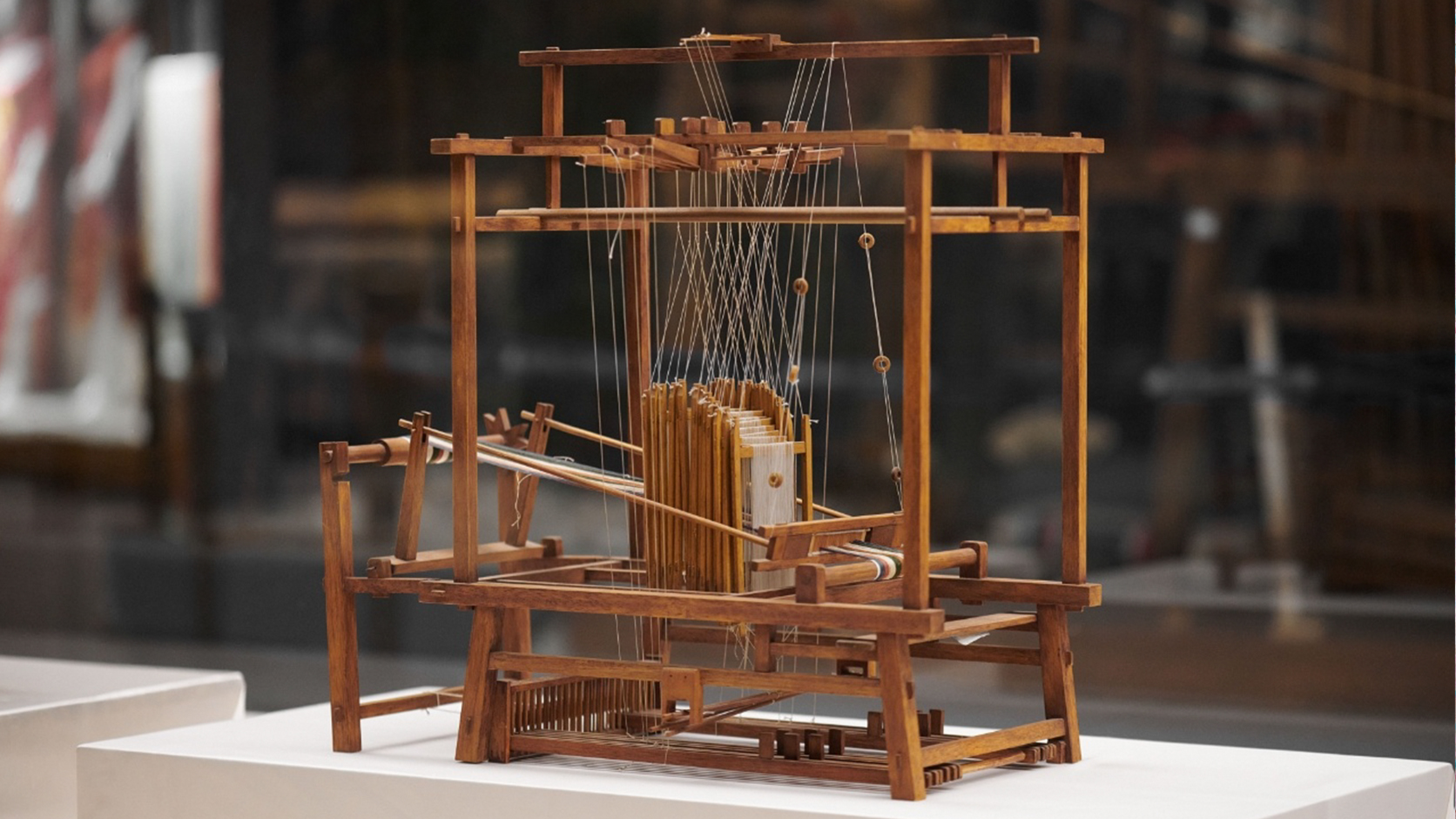
China has four great brocade traditions. Only one is the ancestor of them all—and it weaves its patterns in a direction no other brocade does.
First, What Is a “Brocade”?
If you walk into a fabric store in New York or London and ask for “brocade,” you will likely be shown a heavy, richly patterned fabric—perhaps a silk-blend upholstery weight cloth with metallic threads, or a formalwear fabric with a raised floral design. In Western textile terminology, “brocade” refers broadly to any shuttle-woven fabric with a raised, figured pattern, often incorporating gold or silver threads.
That definition is accurate—but it is also extremely broad. It lumps together textiles from entirely different traditions, made with fundamentally different techniques, serving completely different cultural purposes.
In China, the word jin (锦)—translated as “brocade”—refers to something much more specific: a multi-colored, figured silk fabric woven with a complex structure that produces patterns within the fabric itself, not on its surface. Within this tradition, four great schools emerged: Shu brocade (蜀锦) from Chengdu, Song brocade (宋锦) from Suzhou, Yun brocade (云锦) from Nanjing, and Zhuang brocade (壮锦) from Guangxi.
Shu brocade is the oldest of the four. But age alone is not what makes it different. The real distinction lies in structure, technique, and design logic—differences you can see, feel, and trace back through two thousand years of textile history.
The Fundamental Divide: Warp-Faced vs. Weft-Faced
To understand how Shu brocade differs from every other brocade in China—and from Western brocade as a category—you need to understand one technical distinction that determines everything else.
Shu Brocade: The Warp Does the Work
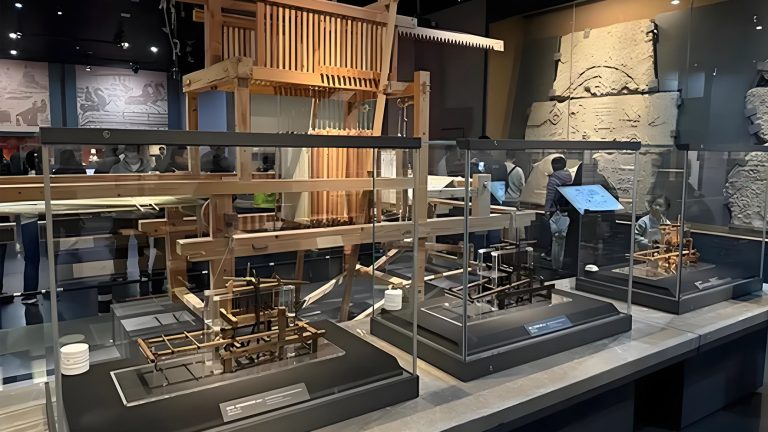
In weaving, there are two sets of threads: the warp (vertical threads, stretched on the loom) and the weft (horizontal threads, passed through the warp by the shuttle). The way these two sets interact determines the fabric’s structure.
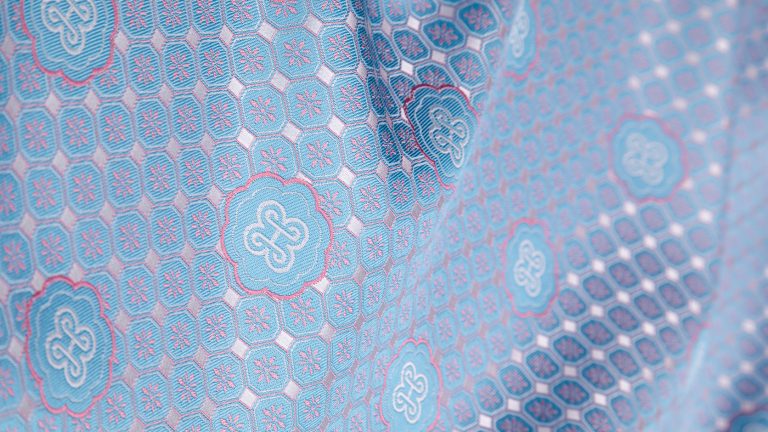
Shu brocade is classified as a warp-faced figured fabric (经锦). Its patterns are created primarily by the vertical warp threads. Multiple layers of colored warp threads are arranged so that different colors rise to the surface at different points, forming the pattern.
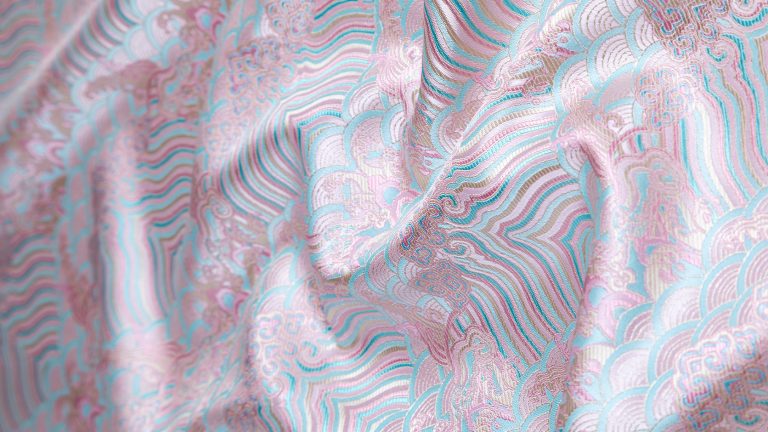
This is not a minor technical footnote. It has profound consequences for how the fabric looks, feels, and behaves. Because the pattern is built from the tightly tensioned warp, Shu brocade has a uniquely dense, tight, and almost carved surface. The pattern doesn’t sit on the cloth—it emerges from the cloth’s internal architecture.
Song Brocade and Yun Brocade: The Weft Takes Over
Song brocade and Yun brocade belong to a different category entirely: weft-faced figured fabrics (纬锦). Their patterns are created primarily by the horizontal weft threads (the weft).
Song brocade, developed in Suzhou during the Song Dynasty but flourishing in the Ming and Qing, uses a two-layer warp system—a face warp and a ground warp—with the pattern woven in by the weft using a three-harness twill structure. This gives Song brocade its characteristic flat, refined, and slightly stiff hand, ideal for book mounting and framed decorative panels. It was never intended to drape.
Yun brocade, produced in Nanjing from the Yuan Dynasty onward, represents the pinnacle of late imperial Chinese weaving. It is defined by its use of “cloud-pattern” (妆花) and “gold-woven” (织金) techniques, incorporating real gold and silver threads and a technique called “through-warp, broken-weft” (通经断纬) that allows unlimited color changes within a single weft passage. Yun brocade is the heaviest and most structurally complex of the three. It was made almost exclusively for imperial use—ceremonial robes, throne drapes, and court regalia—and its visual effect is one of overwhelming, almost architectural grandeur.
The key point: Song and Yun brocades are descendants of Shu brocade. Song brocade was developed in the Tang Dynasty directly on the basis of Shu brocade techniques, inheriting many of its pattern names (such as Badayun and Tianxiale). Yun brocade, which emerged later, was influenced primarily by Ming and Qing-era Shu brocade techniques. Shu brocade is the common ancestor—but it is also the structural outlier, the only one of the three major traditions that remained fundamentally warp-faced in its classical form.
The “Color Organizing” Problem: A Shu Brocade Exclusive
Here is where the difference becomes tangible in the production process.
Every brocade must solve the problem of how to arrange colors before weaving begins. But Shu brocade solves it in a way no other tradition does.
The technique is called “color-stripe warp arrangement” (彩条牵经). Before weaving, the colored warp threads must be arranged in precise sequences across the width of the loom. The weaver uses two distinct methods:
Color-group arrangement (色组分区排列): Groups of colored warp threads are alternated across the fabric’s width to create bold, geometric color blocks. This is the traditional approach used in classical Shu brocade patterns.
Color-gradient arrangement (色阶分区排列): The color groups are arranged in gradual steps, creating a subtle horizontal gradient across the fabric’s width. This technique produced the famous “Moonlight Brocade” (月华锦), where the color transitions from one edge to the other like a spectrum spreading across the cloth.
In the “hand-change-hand” (手换手) warping method used for Moonlight Brocade, the weaver must periodically swap out groups of thread spools while the warp is being wound, carefully maintaining tension and sequence to achieve the gradient effect. This is extremely labor-intensive and requires years of experience to execute correctly.
No other Chinese brocade tradition uses this technique. Not Song, not Yun, not Zhuang. The color-stripe warp arrangement is one of the defining signatures of Shu brocade—the thing that, according to textile scholars, most clearly distinguishes it from its sister traditions.
The consequence is visible in the finished fabric. Shu brocade has a horizontal color logic that other brocades lack. The colors don’t just appear in the pattern—they structure the entire visual field of the fabric.
Pattern Language: What the Motifs Say
The patterns woven into each brocade tradition are not random decoration. They are a visual language, and each tradition speaks a different dialect.
Shu Brocade: Auspicious Symbols, Bold Color
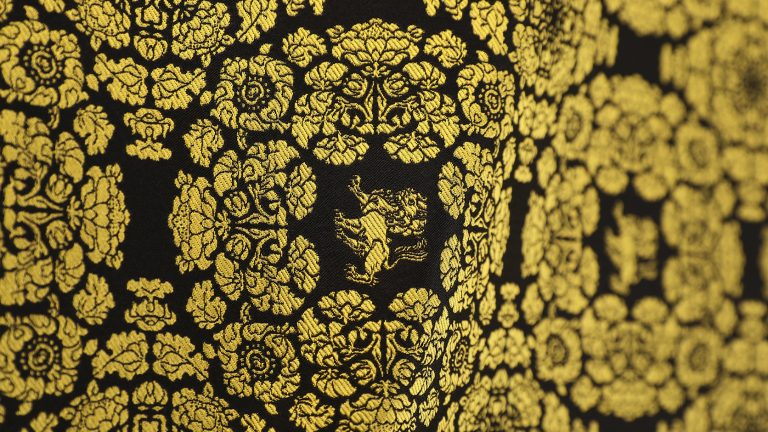
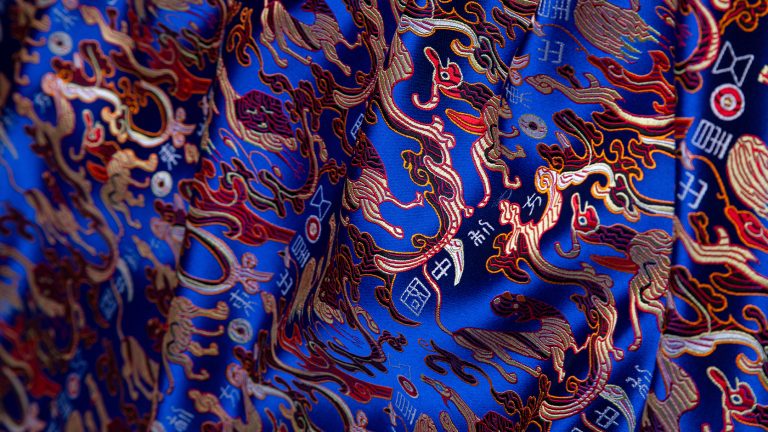
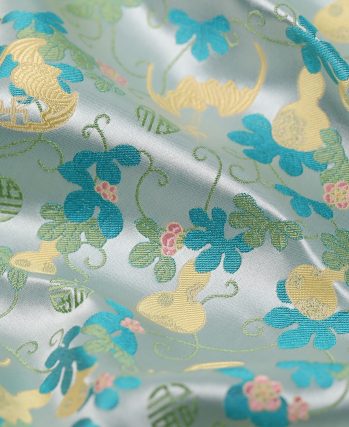
Classical Shu brocade motifs are dominated by auspicious animals and plants: paired birds, confronting beasts, flying phoenixes, dragons, qilin, immortal deer, and the zhuyu (dogwood) plant. These are not decorative flourishes. They are symbols with specific meanings—phoenixes represent renewal, paired birds signify harmony, and the zhuyu plant wards off evil.
The color palette of Shu brocade is characteristically bold and bright. Traditional Shu brocade uses strong contrasts—deep reds against gold, bright blues against greens—arranged in geometric frameworks that contain the animal and plant motifs. The overall effect is one of structured abundance: the composition is tightly organized, but the colors are vivid and the patterns dense.
Song Brocade: Refined, Literati, Restrained
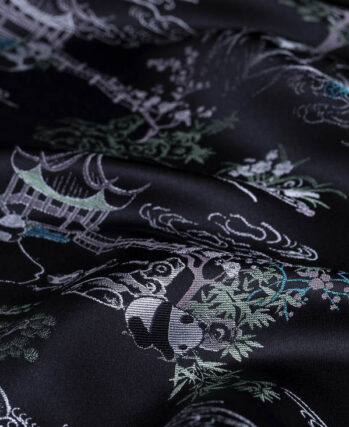
Song brocade’s patterns reflect its Suzhou origins and literati audience. The motifs tend to be more delicate and more pictorial than Shu brocade—flower-and-bird compositions, landscape elements, and geometric medallion patterns arranged with calligraphic precision. The color palette is more muted: soft blues, grays, ochres, and restrained golds.
This is not accidental. Song brocade was developed primarily for book mounting and framed art, not for garments. Its purpose was to frame and complement paintings and calligraphy, not to compete with them. The aesthetic is one of restrained elegance, not exuberant display.
Yun Brocade: Imperial Grandeur, Maximum Complexity
Yun brocade is the opposite extreme. Its motifs are large-scale, symmetrical, and hierarchical—dragons and phoenixes arranged in formal compositions that convey imperial authority. The color palette is maximally rich: deep purples, imperial yellows, brilliant reds, and extensive use of real gold and silver threads woven into the surface.
Yun brocade was made for the emperor’s eyes only (or nearly so). Its purpose was not to be beautiful in a domestic sense, but to be overwhelming in a ceremonial one. Every element—the density of the weave, the brilliance of the gold, the scale of the pattern—was designed to communicate absolute power.
The Takeaway
Shu brocade’s patterns are auspicious and structured. Song brocade’s patterns are refined and restrained. Yun brocade’s patterns are imperial and overwhelming.
All three are “brocade.” But they are doing completely different visual and cultural work.
Shu Brocade vs. Western Brocade: A Different Category Entirely
Now let’s address the comparison that American readers are most likely to make: How does Shu brocade compare to Western brocade?
Western Brocade: A Broad, Loose Category
In European textile history, “brocade” developed as a category of decorative fabric, not a single tradition. Venetian, Florentine, and French brocades from the Renaissance and Baroque periods were typically weft-faced, often incorporating metallic threads, and used for upholstery, ecclesiastical vestments, and aristocratic garments.
The defining feature of Western brocade is its visual effect: a raised pattern that catches light, often with a metallic shimmer. The patterns tend toward European floral and architectural motifs—acanthus leaves, cartouches, scrollwork, and heraldic elements.
The Critical Difference
Western brocade is pattern applied to cloth. Shu brocade is pattern constructed within cloth.
In most Western brocade, the base fabric and the pattern are two separate systems—the ground weave provides the background, and the pattern is created by supplementary weft threads floated over the surface. The pattern can be sheared off (as in cut velvet or ciselé brocade) or left floating (as in fil coupé). Either way, the pattern is a surface event.
In Shu brocade, the pattern is the structure. There is no “background” and “pattern” in the same way. The colored warp threads interlace to form both the ground and the pattern simultaneously. If you turn a piece of Shu brocade over, you will find that the back is as structurally complex as the front—not a mirror image, but a different expression of the same woven system.
This is why Shu brocade feels heavier and more substantial than most Western brocades of comparable size. It is not “thicker” in the sense of having more material piled on top. It is denser in the sense that the entire thickness of the fabric participates in the pattern.
The Historical Chain: Shu Brocade as the Source
Here is the fact that ties everything together: Shu brocade is the ancestor of the other Chinese brocade traditions.
- Song brocade was developed in the Tang Dynasty on the basis of Shu brocade techniques. Many Song brocade pattern names are identical to Shu brocade pattern names—Badayun, Tianxiale, Fangsheng Yinan—because they were inherited directly from the earlier tradition.
- Yun brocade emerged later, drawing primarily on Ming and Qing-era Shu brocade techniques for its structural foundation.
- Japanese Nishijin brocade, one of Japan’s national treasures, is historically derived from Tang Dynasty Shu brocade. The Japanese even call it “Nihon no Shukkin”—literally, “Japanese Shu brocade.”
Shu brocade is not merely one option among many. It is the common ancestor, the technical foundation, and the standard against which all later figured silk traditions in East Asia were measured.
This is why it is called “the Mother of Chinese Brocades” (天下母锦).
Summary: What Makes Shu Brocade Different
| Dimension | Shu Brocade | Song Brocade | Yun Brocade | Western Brocade |
|---|---|---|---|---|
| Structure | Warp-faced (经锦) | Weft-faced, two-layer warp | Weft-faced, complex weft systems | Typically weft-faced |
| Color logic | Color-stripe warp arrangement (彩条牵经) | Pictorial color placement | Unlimited color via broken weft | Surface pattern placement |
| Surface effect | Dense, carved, dimensional | Flat, refined, slightly stiff | Heavy, metallic, ceremonial | Raised, often metallic |
| Typical use | Garments, accessories, gifts | Book mounting, framed art | Imperial regalia | Upholstery, vestments, formalwear |
| Historical role | Ancestor of Song, Yun, and Nishijin | Descendant of Shu | Descendant of Shu and Song | Independent tradition |
The One-Sentence Answer
Shu brocade is the only major Chinese brocade tradition that weaves its patterns from the warp—vertically, within the structure of the cloth—rather than from the weft; and it is the ancestor from which the other traditions descended.
That single structural fact—warp-faced, not weft-faced—is the key to everything else: the density, the color logic, the carved surface, and the two-thousand-year history that makes Shu brocade the original among China’s great brocades.
Explore our collection of authentic Shu brocade pieces and experience the difference for yourself—the density you can feel, the colors that shift with the light, and the weight of a tradition that predates the Silk Road itself.